1. Introduction Whenever I talk about growth—real, scalable, revenue-shifting growth—I always circle back to one thing: digital. And if there’s one city that has quietly but confidently built a reputation for digital mastery, it’s Chandigarh. Over the past few years, I’ve seen businesses here evolve from old-school marketing to a full-blown digital transformation wave. And honestly? It’s refreshing. What really fascinates me is how Chandigarh has turned into this blend of calm creativity and sharp marketing intelligence. You walk through Sector 17 or sit in a café in Phase 11, and you’ll find founders brainstorming funnels, designers sketching brand stories, and marketers optimizing ad campaigns on the fly. There’s a buzz—subtle but powerful—that tells you the city is shifting gears. This evolution didn’t happen overnight. With strong education institutes, a tech-aware youth, and a growing appetite for innovation, Chandigarh has become a hotspot for brands aiming to build authority, visibility, and long-term digital presence. So when someone asks me where to find the Best Digital Marketing Services in Chandigarh, I don’t just hand them a list—I share the bigger picture. This city is more than a service provider hub; it’s a rising digital ecosystem, ready to shape the next wave of online success. 2. Why Choose Digital Marketing Services in Chandigarh? Strategic advantages: talent pool, affordability, innovation culture Chandigarh has a knack for producing smart, creative, tech-savvy talent. Maybe it’s the education system, maybe it’s the startup buzz—whatever it is, agencies here attract people who think differently. You get metro-level quality without metro-level prices. And trust me, when you’re scaling a brand, this balance of affordability + excellence is a huge win. Plus, the innovation culture is ridiculous—in the best way. Agencies here don’t just follow trends; they experiment, break patterns, and build forward-thinking strategies. Rise of emerging agencies and startup-forward mentality Every time I walk into an agency office here, there’s this electric vibe—young teams, fresh energy, sticky notes everywhere, and brainstorming sessions that go off like fireworks. Startups in Chandigarh have pushed agencies to be sharper, quicker, more adaptive. That pressure has birthed a new generation of digital marketing companies that operate with agility and ambition. How local agencies blend creative storytelling with data-backed execution Here’s what makes Chandigarh’s digital scene special: we storytell with heart but execute with science. Agencies here know how to merge emotional brand narratives with hardcore analytics—kind of like mixing poetry with spreadsheets. When creativity meets data, magic happens… and conversions follow. 3. Key Digital Marketing Services That Drive Impact 3.1 Search Engine Optimization (SEO) SEO in Chandigarh isn’t just about keywords—it’s a full ecosystem. 3.2 Social Media Marketing (SMM) Social media is where brands show their personality—and Chandigarh agencies know how to make it pop. 3.3 Pay-Per-Click (PPC) Advertising When you want fast results, PPC is your tactical weapon. 3.4 Content Marketing Good content pulls attention. Great content holds it. 3.5 Website Design & Development Your website is your digital HQ—and in Chandigarh, dev teams take that seriously. 3.6 Email & Automation Services Email isn’t old-school. It’s underrated. 4. Top Digital Marketing Agencies in Chandigarh Curated list of leading agencies (without bias) While I won’t crown just one agency, here are some names consistently known for delivering value: Quick summaries: specialties, strengths, industries served Why they stand out in the saturated market 5. How to Choose the Right Agency for Your Business Key decision-making criteria Red flags to avoid Checklist for evaluating digital partners 6. Benefits of Hiring a Chandigarh-Based Digital Marketing Agency Cost-effective scalability You get premium quality without burning your budget. Local market + consumer behavior insights Teams here understand the regional pulse—from cultural nuances to buyer habits. Personalized support and faster turnaround times Small enough to care, big enough to perform. 7. Real-World Case Studies (Optional) Short success stories from Chandigarh businesses I’ve seen small cafés turn into viral hotspotsStartups go from zero to booked-outLocal brands expand nationwide Tangible metrics Real outcomes matter Not just vanity metrics—actual revenue shifts. 8. Pricing Guide: What to Expect Typical service pricing ranges in Chandigarh Factors that influence cost Value-vs-price positioning insight Cheap doesn’t equal good.Good doesn’t always have to be expensive.Find the sweet spot. 9. Future of Digital Marketing in Chandigarh AI-powered workflows From content automation to predictive analytics, AI is rewriting how agencies operate. Hyper-personalization trends The future is custom—right message, right person, right time. Growth of performance-driven digital ecosystems Chandigarh is evolving into a results-first digital hub, not just a creative one. 10. Conclusion When I look at the digital scene in Chandigarh, I see a city that’s not just catching up—it’s quietly building a league of its own. If you’re searching for the Best Digital Marketing Services in Chandigarh, you’re stepping into a market shaped by creativity, powered by data, and fueled by young, ambitious minds who genuinely want brands to win. What makes Chandigarh special is its balance: the calmness of a well-planned city mixed with the hunger of a rising tech hub. Agencies here don’t just deliver services—they build relationships, craft stories, and engineer long-term growth engines. Whether you’re a startup aiming for visibility or an enterprise ready to scale, this city offers the perfect mix of talent, affordability, and innovation. So if you’re ready to elevate your digital presence, Chandigarh is more than a smart choice—it’s your launchpad for the next big leap. And trust me, the future here is only getting brighter.

1. Introduction Whenever I talk about growth—real, scalable, revenue-shifting growth—I always circle back to one thing: digital. And if there’s...

Introduction Every year, I watch the marketing world reinvent itself like a startup in a constant pitch meeting. And here...
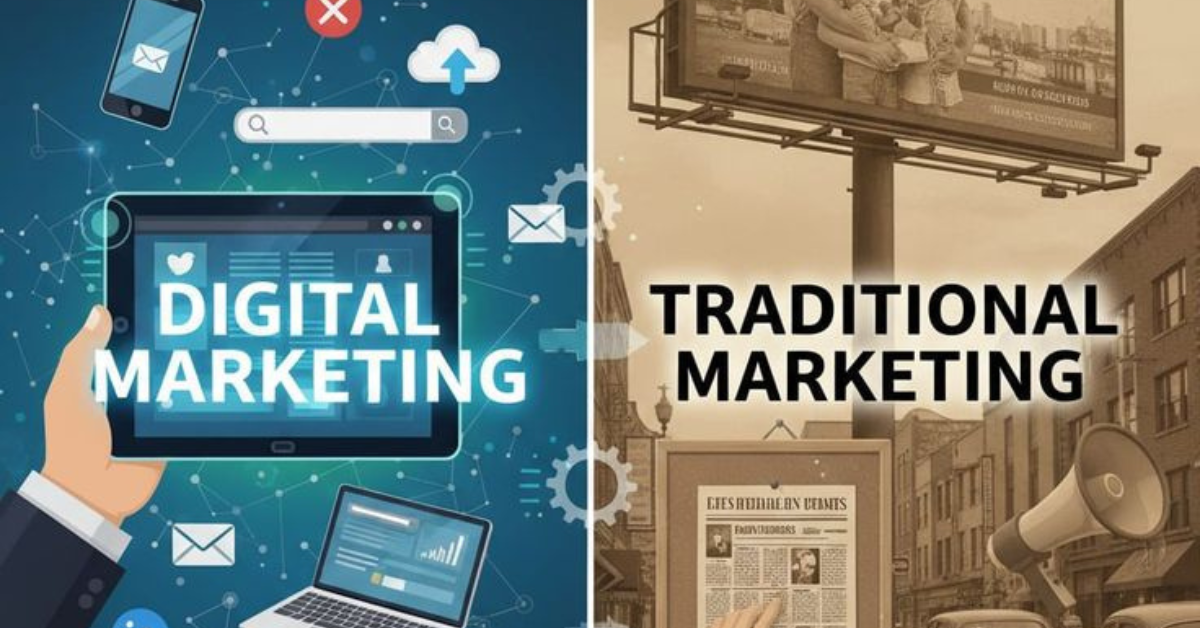
Introduction Every year, I watch the marketing world reinvent itself like a startup in a constant pitch meeting. And here we are in 2026, still debating Digital vs Traditional Marketing like it’s the Super Bowl of brand strategy. I’ve lived through countless campaigns—some powered by algorithms, others printed in magazines my parents still swear by. This debate isn’t just academic; it’s deeply practical. It shapes budgets, hiring decisions, brand storytelling, and ultimately, the way customers find us, trust us, and convert. So let’s get into the trenches—from billboards to Instagram reels—and decode which strategy truly delivers impact in 2026. What Is Digital Marketing? Digital marketing is the wild, electric playground where brands meet audiences through screens. It includes SEO, social media, PPC ads, email marketing, influencer collaboration, content strategy, automation, and more. What I love about digital is the agility. I can launch a campaign today, test it tonight, optimize it tomorrow, and scale it next week. It’s like having a marketing cockpit—data dashboards lighting up, customer behaviors mapped in real-time, and opportunities ready to take off at the click of a button. What Is Traditional Marketing? Traditional marketing is the OG. It’s everything we grew up seeing—TV commercials, brochures, radio jingles, newspaper ads, billboards, flyers, posters, even direct mail. It’s tangible. It’s familiar. It’s powerful in ways digital sometimes can’t replicate. There’s a kind of nostalgia baked into traditional touchpoints. And while the corporate world loves to sprint toward digital innovation, traditional media still commands massive trust and reach—especially in local markets and broad audience demographics. Key Differences Between Digital and Traditional Marketing Reach and targeting Digital helps me narrow down audiences with sniper-like precision—interests, age, location, intent. Traditional marketing broadcasts widely, perfect for mass awareness or city-level domination. Cost and ROI Digital is generally more budget-friendly, giving me control to scale up or down. Traditional campaigns often require heavier upfront investment. Measurement and analytics Digital wins here—nothing beats instant data, click-throughs, heat maps, and conversion tracking. Traditional metrics lean on surveys, projections, and estimations. Consumer behavior alignment Consumers spend hours online, but traditional media still captures attention in public spaces and offline environments. Each wins in different moments of the day. Personalization capabilities Digital allows hyper-personalization—dynamic ads, custom emails, retargeting. Traditional personalization exists but is much more limited. Speed and adaptability Digital lets me change creatives mid-campaign. Traditional? Once printed or aired, it’s set in stone. Interaction style (one-way vs two-way communication) Digital is conversational. Traditional is a monologue. Both have strategic value depending on the campaign goal. Real-world examples Digital Marketing Advantages Digital marketing brings data-driven clarity. Here’s what makes it a powerhouse: In short, digital is efficient, measurable, and adaptable—the kind of combo every marketer dreams of. Traditional Marketing Advantages Traditional marketing may feel old-school, but its strengths still hit hard: High brand recall A billboard or TV ad can imprint a message in a way digital ads sometimes can’t. Credibility with mass audiences People often trust what they see offline—print and broadcast still hold authority. Strong for local or broad reach If I want to target a whole city, traditional channels do it flawlessly. Tangible brand experience Brochures, packaging inserts, and direct mail create physical touchpoints. Emotional impact TV ads and radio jingles can tap deep into feelings. Case studies Think of Coca-Cola’s holiday commercials or McDonald’s highway billboards—they still drive real-world action. Limitations of Digital Marketing Even the digital world has its rough edges: Algorithm dependency Platforms decide who sees your content. High competition Every brand is fighting for the same digital attention span. Ad fatigue Users get tired of repetitive ads. Learning curve Tools and trends evolve fast. Privacy concerns Cookie restrictions and GDPR keep shifting the playbook. Limitations of Traditional Marketing Traditional marketing also has its constraints: High cost TV, radio, and print space are pricey. Harder to track ROI You know the results—but rarely with precision. Low flexibility Changes require reprints or renegotiations. Long production cycles Design to distribution takes time. Limited personalization Everyone sees the same message. Digital Marketing vs Traditional Marketing: Side-by-Side Comparison Table Factor Digital Marketing Traditional Marketing Cost Low–Medium Medium–High Reach Global Local/Broad ROI Highly trackable Hard to measure Targeting Precise Broad Analytics Real-time Limited Consumer Engagement High (interactive) Low (one-way) Speed Fast Slow Best Use Cases Lead gen, e-commerce, personalization Awareness, trust, mass campaigns When to Use Digital Marketing Digital shines when you need: Ideal businesses Startups, D2C brands, SaaS, e-commerce, personal brands. Best scenarios Lead generation, retargeting, conversions, online visibility. Types of campaigns Social ads, search ads, email funnels, content marketing. Funnel stages Consideration, conversion, and retention—digital crushes it here. When to Use Traditional Marketing Traditional thrives in situations where presence and trust matter: Ideal businesses Local shops, FMCG, real estate, healthcare, hospitality. Industries still dominated by traditional Automotive, luxury brands, retail chains. Best scenarios Brand awareness, mass exposure, credibility building. Offline touchpoints Billboards, event stands, radio sponsorships—these still hit hard. The Hybrid Approach — Integrating Digital and Traditional Marketing The sweet spot in 2026 is where both worlds meet. Why 2026 belongs to omnichannel brands Consumers move seamlessly between screens and streets—your marketing should too. How to merge both worlds Combine QR codes on posters, track engagement via UTM tags, sync TV campaigns with Google Trends monitoring. Examples Balanced funnel strategies Awareness offline → conversions online → retargeting digital → loyalty loops across platforms. Future Trends: The Evolution of Digital vs Traditional Marketing Looking ahead, here’s what’s reshaping the battlefield: AI personalization Bots crafting customized journeys. Voice commerce Search evolving beyond screens. AR/VR touchpoints Immersive shopping experiences. Connected offline retail Smart billboards and digitalized store experiences. Privacy-first marketing shifts Less tracking, more trust-building. Conclusion So, who wins in the epic battle of Digital vs Traditional Marketing?Honestly—neither. And both. In 2026, the brands that win aren’t the ones picking sides, but the ones creating harmony. Digital brings precision, scale, and speed. Traditional brings trust, impact, and presence. Together, they create campaigns that feel human yet data-driven, emotional yet trackable. When you blend the old-school